Interview by Denis Hirson with Anne Sauzey on 29th April 2025, late afternoon in her apartment near Concorde, Paris.
As far as I know, you have practiced three art forms: painting, photography and collage, is that the full list?
If you can make the distinction between the three of them, yes.
Can you tell me when you started making collages?
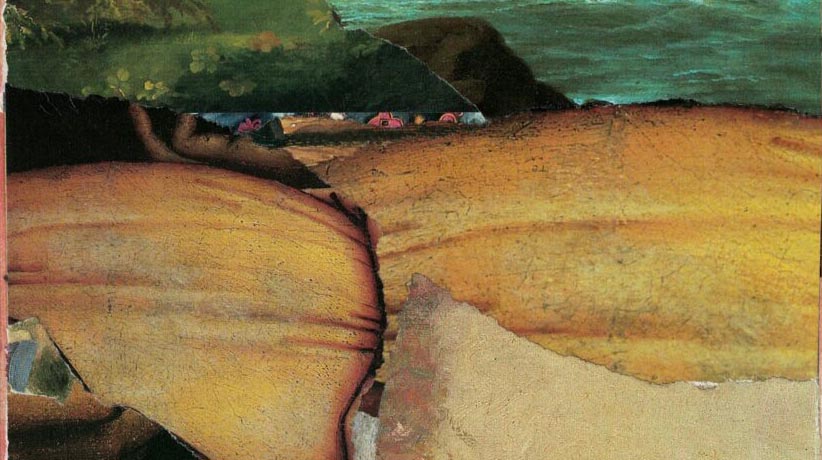
Absolutely, yes. It was in 1978, after a trip to Israel. What inspired me when I came back from that trip was that I wanted to capture the sand, the vast desert. I didn’t know how to express it, it didn’t occur to me to paint it. Somehow, I reached for sandpaper and started pasting. I added color to some areas (pasted paper and paint as well) because I felt the whole place was punctuated with colors but, basically, it was a mass of landscape with little variation with a few roads, distant homes, cabanas, sometimes cars, and those created a kind of quiet rhythm and punctuation. I began to collage then though I continued drawing and painting.
You once told me that you almost never work outside of your studio. Why do you need to work in that space?
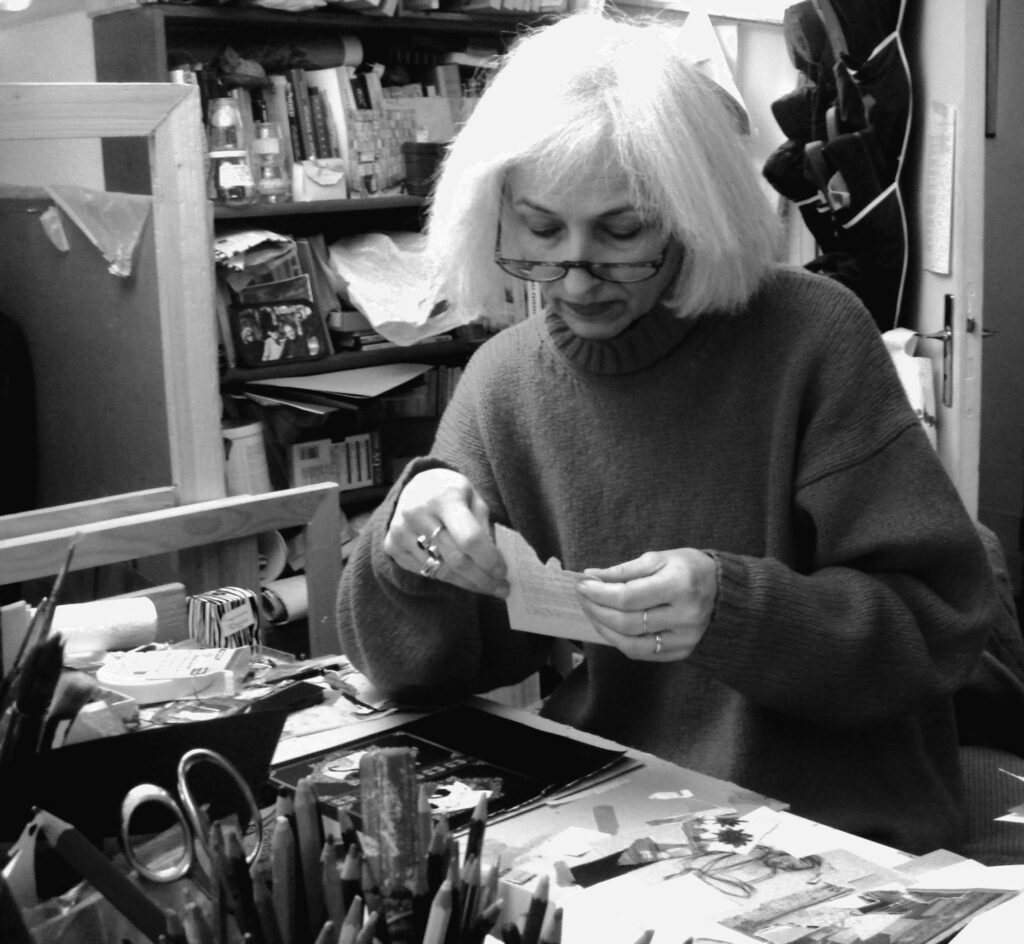
Because I have to forget everything, to not be stimulated by sound. I need my table, I need my basic materials and an almost studious, stable position. But If I go somewhere for a week, sometimes more, I may find a piece of paper that will inspire me to do something with it then and there. I usually carry glue with me for those stays, just in case. Still, I have to have settled there for a bit of time.
One of my self-portraits was done in Washington D.C, other collages have “happened” in Rome, in Saint Jean de Luz and Vancouver, but I stayed in those places for a bit of time. I have to feel somewhat at home. I need that box around me. It’s another border.
And you need a feeling of isolation?
Isolation, quiet, no stimulation or distraction from the outside. By the time I get to my studio, I have filtered experiences, a certain amount of information that I may not be aware of at the time. But, at some point, it is time to put my hands to work.
I occasionally take a few weeks, maybe a month off from working in the studio to casually and unself-consciously gather elements and sensations; to see exhibitions, travel, go on outings. Those periods are when I read more, think more, watch more and converse more.
Then I return to the studio. It is a box and I’m in the box. In Chinese astrology I am a rabbit so I need my cage.
But rabbits can also run free.
I can run free too, but not while I’m working.
Do you find your material in any specific place, or do you buy it?
No. I can go to a restaurant and fiddle with paper mats, napkins, menus, chocolate wrappers and doilies. I am – we are – surrounded by paper: magazines, calendars, brochures, even though there’s less printed matter today than in the 80s and 90s.
Anything I choose must be of a fairly good quality and it has to speak to me in its color, its texture, even if there is relatively little texture, but also in its depth. It needs to have a certain tenue.
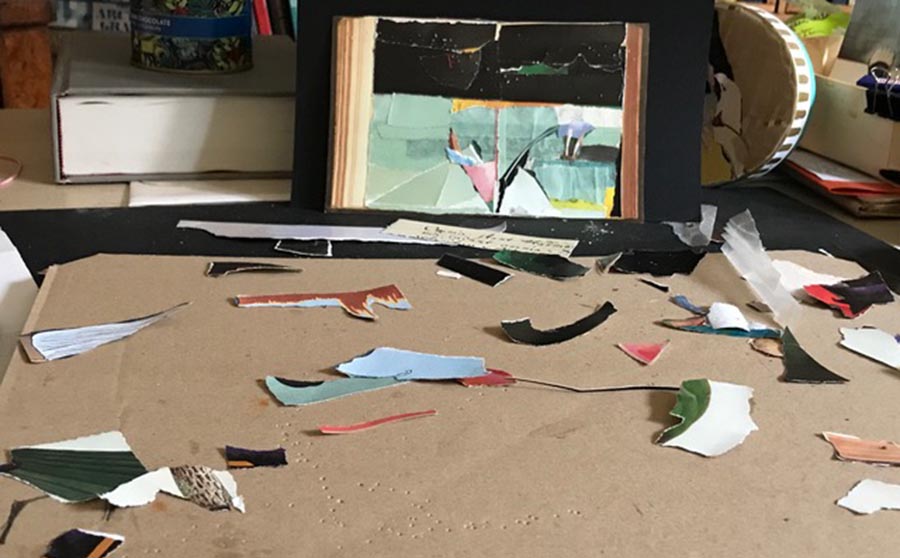
I keep many small trays filled with papers that I have torn, mostly collected together by color, so I can use them later. They are my palettes. Sometimes I keep something as big as a postage stamp. For some reason, their colors differ in vibrancy from other printed matter and I particularly like the perforations.
You like edges.
For me, edges are essential. In painting or in collage, making the edge is one thing, but paying particular attention to the edge is even more important. Sometimes I am critical of a painting, any visual work, by the way the edges are treated. I think: No, they went to the inside of the surface but they neglected the outside. I don’t like the white of gesso on the canvas unless it is supposed to be there and, somehow, I think I can sense when it hasn’t been given attention.
When I am working on a collage I start at an edge, I start at a corner. Often, it is the top left-hand corner, almost like reading a page. Then I can move to the bottom or the middle and figure out the rest, but I always start with an edge. It’s a sort of compass.
When Eugène Nicole* writes about your work, he mentions “le corps blanc”, the white body that is exposed when you tear paper. Can you comment on that?
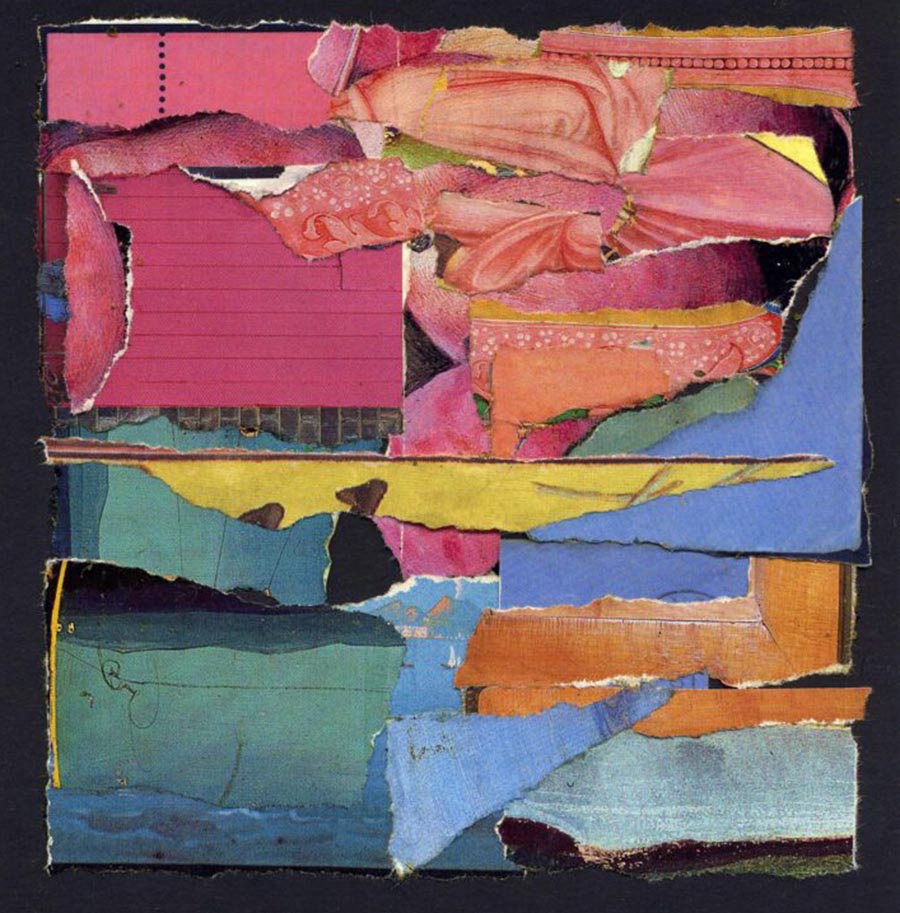
The white comes from the tearing of color because paper, especially printed paper, is white on the inside, so even if the surface is covered with a photograph or some other kind of image, when you tear it you see that it is essentially made of white. I am conscious of this when I’m working with the body of the paper.
What does it mean to you to be exposing that body?
It can mean different things in different visual situations. Sometimes it is about a tear, sometimes it is about a scar; sometimes it is about a plane as against another plane. Edges, whether exposing a body or not, also create form. Often times they give a direction, a road that your eye can pick up. This allows you to travel in the piece, and traveling in a piece takes you to a place or an event.
I wouldn’t know how to explain why but, somehow, I start in the north, I mean, as I have said, at the top left or right-hand corner. There is a rhythm, my eye needs to go from one place to another and that white line can sometimes give me the direction, almost like a road map or a kind of blueprint for some sort of architecture or animation to come.
You say “north”. You really are traveling in a landscape when you work. And at the same time that you are making this landscape, you are also undoing the pieces you are working with.
I’m an editor. I start off with the beginning of a story, often at the top of the surface, much like the page of a book. I then roam. Partly because of the size of the collage, it is a search. Maybe it is like entering a grotto.
Does the process of tearing, and therefore undoing, mean something to you, in and of itself?
Undoing something is capturing what appeals to you. You seize something, a color or a shape, and you’ve already changed it before you’ve touched it, because you have isolated it with your eye. And then, when you start to tear it out of its initial context, it becomes something completely different. I select things that have had a life, that have served another purpose. A yellow rectangle might have been a sofa in an advertisement for a piece of furniture and I will give it another role, because for some reason it lures me.
At the same time, I imagine that when you are tearing, you are not always entirely in control.
I think I have learned how to tear according to my wishes, though I don’t always know what my wishes are going to bring me. But they always bring something and, somehow, there is a sort of destiny. The work may not go where I thought it would go but it will go somewhere, at some point. I trust each fragment to find its place.
I tear it in two and I’ve already done something, revealed something. In a way, I’m creating a kind of tension, a contradiction. A line, — the white flesh or a color — appears and disrupts so that I have to do something to the paper, and then do something again.
Sometimes it’s a messy process. But there is serendipity in the lapses of control. You control, control, control but, ultimately, even in painting, the best work I have done, in my view, came as a surprise to me, as if someone else had created it.
To return to the question of edges, it seems to me that you are, at least sometimes, at the edge of words.
I’m at the edge of words and ideas. One of the reasons I enjoy doing collage is that, for me, it is the closest medium to words – books, novels, magazines – in terms of method. It involves rearranging, whether it is the color, shapes or textures that are attracting me. They function much as words do, they are vocabulary. A certain eloquence is possible in a collage. It is a kind of a storytelling.
It is also true that I do collage onto images of books, parts of actual books or book covers. They are a place of comfort from which to work, a prop at times or a reinforcement of the unknown storyline to come. Sometimes it feels like an evolving story. Sometimes it feels as if I am interrupting a narrative.
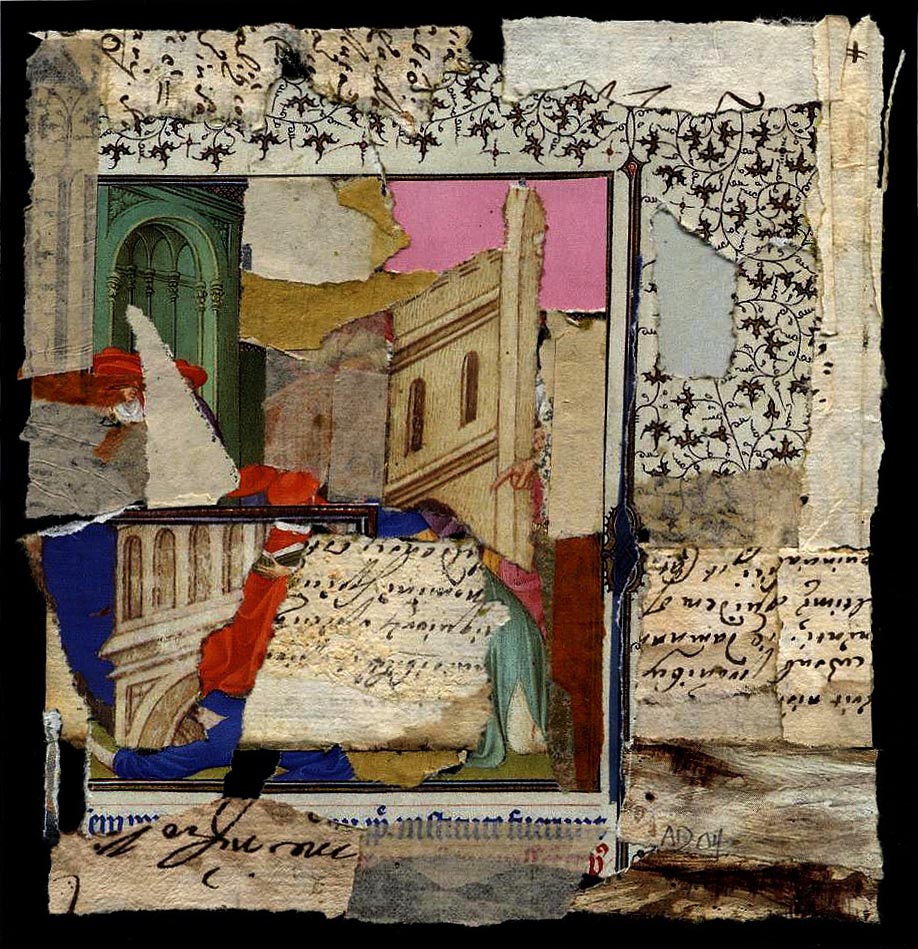
Could we put it this way: the collage approaches but does not reach a definition of things, they remain unnamed in a kind of suspended landscape. And that landscape generates a quality of silence.
I agree with you about the silence and, I suppose, that’s where my imagination goes. I’ve never thought about it that way, but it moves me to hear your thoughts on this because I recognize a truth about what I am doing.
It’s a silence and it’s also an absence, because sometimes those spaces between the various volumes of the collage are like intervals. Something will happen there, in that landscape, interior or exterior. Inevitably something will happen there, it just isn’t explicit but it is implied, so there is silence and suspense. Presence and absence.
What you do sounds like jazz to me, escaping from the easy, the tuneful… there is always a tilt. The music may start with a tune but there is a continuous refraction, a tangent.
Yes. There is something of melody, and then improvisation with branches and echoes, going here and there. We touched on that when we talked about the role of a line or a tear, whether a separation or merely directional. It appears in one area and the eye catches it again in another. It is, indeed, very much like jazz.
But, even if your work makes me think of jazz, it is filled with silence. The jazz is happening but you’re working in silence. The result is a kind of visual music that comes out of silence.
You’re opening my eyes and my ears to something I have never put words to or even thought of. I am becoming conscious of what my unconscious, maybe my working consciousness, is doing or has been doing. It is disconcerting, but I think you’re right.
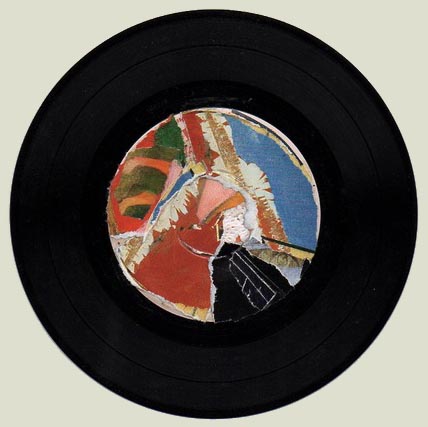
When you started working with record labels, in the middle of the vinyl, your work was surrounded by the potential of music, not words but music, which, of course, was silent. So we had the suspended silent collage in the middle, augmented by the silence of the music that wasn’t playing.
I like that contradiction, that frustration. It gave that black surface a meaning and a force. I didn’t need to frame the area of collage. There was a sort of centrifugal force. I began to make those collages because for my own reasons I had stopped listening to music. I had to silence what had become too hard to hear. Now the records still exist, transformed. A place within which to put another place.
And then there is the color black, a very important ingredient for you.
First of all, I consider it a color, contrary to any scientific perspective. It is black but it becomes something else when it is placed next to a different color or shape. It becomes a place unto itself. It becomes a presence. When people say that black is not a color, I don’t understand them.
Black is never black, especially when it is printed. Every color is changed when next to another and when light falls upon it. Every printed piece of paper, black or other, is full of nuances and is never totally anything. The only color that is completely white is the paper when you tear it and, even then, there is white and there is white.
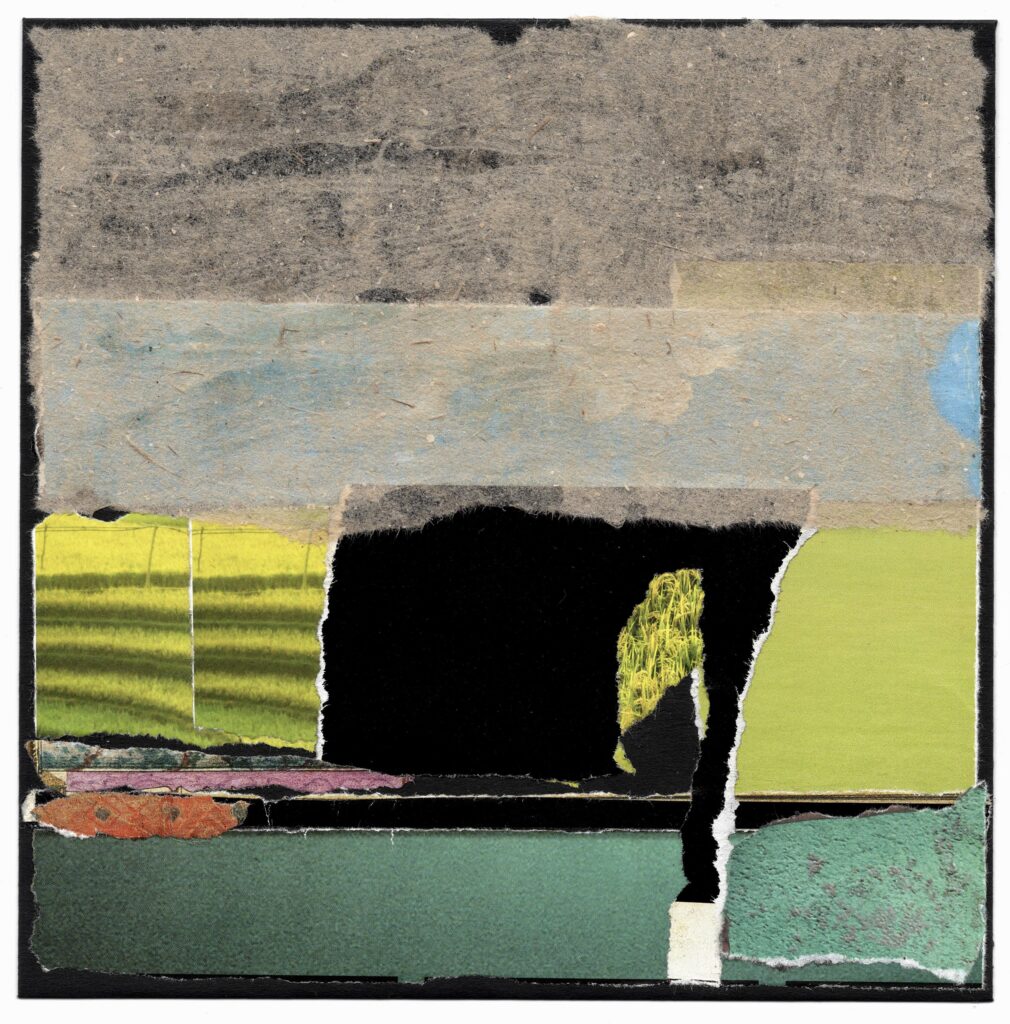
And then there are moments when you seem to have wanted to disturb the image. You’ve scratched it, poked it and pricked it. Maybe you’ve wanted to break into it, or break out of it?
Often times, when I work like that, I want to see what is behind the surface. I want to see what things look like through those pinholes or punctures. What that does is animate the event. It isn’t about the composition per se, but it says that this is not just a flat surface – there’s a certain three-dimensionality that hints at something beyond that surface. Something is happening there, too. Whether under a rock or in the sky, and everywhere in-between, there are endless numbers of events taking place.
To end with, would you say something about the scale of your work?
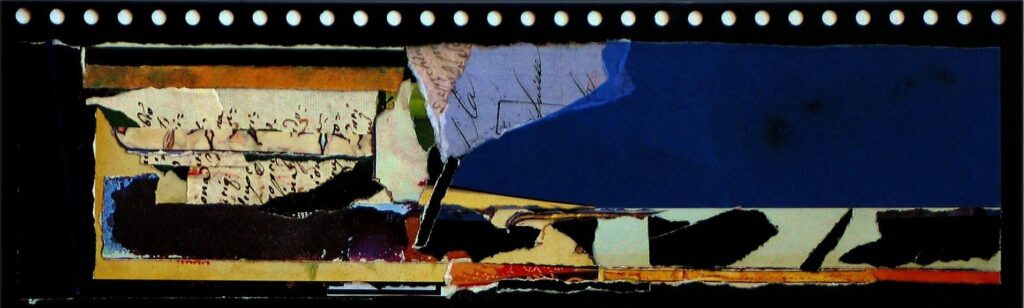
I think the question of scale is technical, and at the same time it coincides with what we were saying about silence. Silence and control. Technically, the size is dependent upon the paper that I am using and, generally, as I am using printed paper, it is usually limited in size. And since I destroy the printed images, the papers I am using are smaller than in their original contexts.
On another level, the fact that they are small makes one enter the image fully with eyes and mind.
If you are in front of a large painting, say, a Francis Bacon or a Rothko, you don’t have to enter it. Sometimes it prevents you from entering because it imposes itself on you and you have a more physically and mentally passive response. This doesn’t mean you don’t experience it visually and spiritually or even technically. Some of the artists whose works I most admire work on very large formats and they impose themselves beautifully. I would even say they impress me.
Work at a smaller scale needs to be physically approached, and that proximity to the eye makes you look at the details, the story, those edges, much like a book, in that sense. It is more confined, more confidential and, probably, on my part, it allows for more control. The collages become a sort of cabinet de curiosités, demanding a different effort on the part of the viewer.
My point is that a small format can be even bigger than a large format, by different means. A small Picasso or a small Bacon, Fautrier or Sonia Delaunay are not life-size but mind-size.
I find it moving to look at small works in any medium, really. Maybe it is the work of the hands, the fingers and the closeness between the artist and the work as it develops that, as a viewer, I identify with.
I think working on a large painting is gesturally liberating, whereas collage is liberating in my visual arena. It isn’t about my body, my arms, my weight, my physical force to tame the spaces I was creating with paint. It is in my hands. Also, in the paintings, the canvas determined the outer edges and, though I paid attention to them, I didn’t control them and didn’t travel through the spaces I was creating in the same way as when I am making a collage.
____
* Eugène Nicole’s essay “Des Collages qui nous regardent » is included in this website with its English translation: “Collages, with an eye on us”.